
Short answer. NFPA 70E-2024 requires an arc flash risk assessment before work where an arc flash hazard may exist, and puts establishing an electrically safe work condition first. An ICARUS Ops EES procedure makes it simple for crews to apply the risk controls in the proper order and prove it was done correctly.
Definition. Arc flash is a release of heat, light and pressure caused by an electric arc between conductors or to ground. It can cause fatality, severe burns and other serious injuries.
Arc flash risk assessment
NFPA 70E Article 130 describes the arc flash risk assessment: identify the hazard, estimate its likelihood and severity, and decide the protective measures and PPE. Incident energy calculations are often done per IEEE 1584-2018, and the results appear on equipment labels.
The hierarchy of risk control
- Elimination: de-energize and establish an electrically safe work condition.
- Substitution.
- Engineering controls.
- Awareness.
- Administrative controls, including written procedures.
- PPE.
Where procedures fit
A procedure does not change the hazard. It helps crews apply the controls the risk assessment chose, in the right order: scanning a QR or barcode to verify the lineup when required, establishing the electrically safe work condition where required, and stopping at hold points.
Where EES procedures fit
The ICARUS Ops Error Elimination System (EES) shows the PPE a job requires as soon as a checklist opens, prompts it again after a pause, and runs each step in order with photo proof and sign-off at critical steps. Procedure authors add a warning right before critical steps that shows the hazards and the required PPE, and the crew must acknowledge it before starting the hazardous work. A procedure does not eliminate the hazard. It ensures crews apply the controls and risk mitigation in the right order.
EES procedures guide crews through:
- Confirming the lineup or asset PPE requirements.
- Establishing the electrically safe work condition.
- Where required, stopping at appropriate hold/QA points.
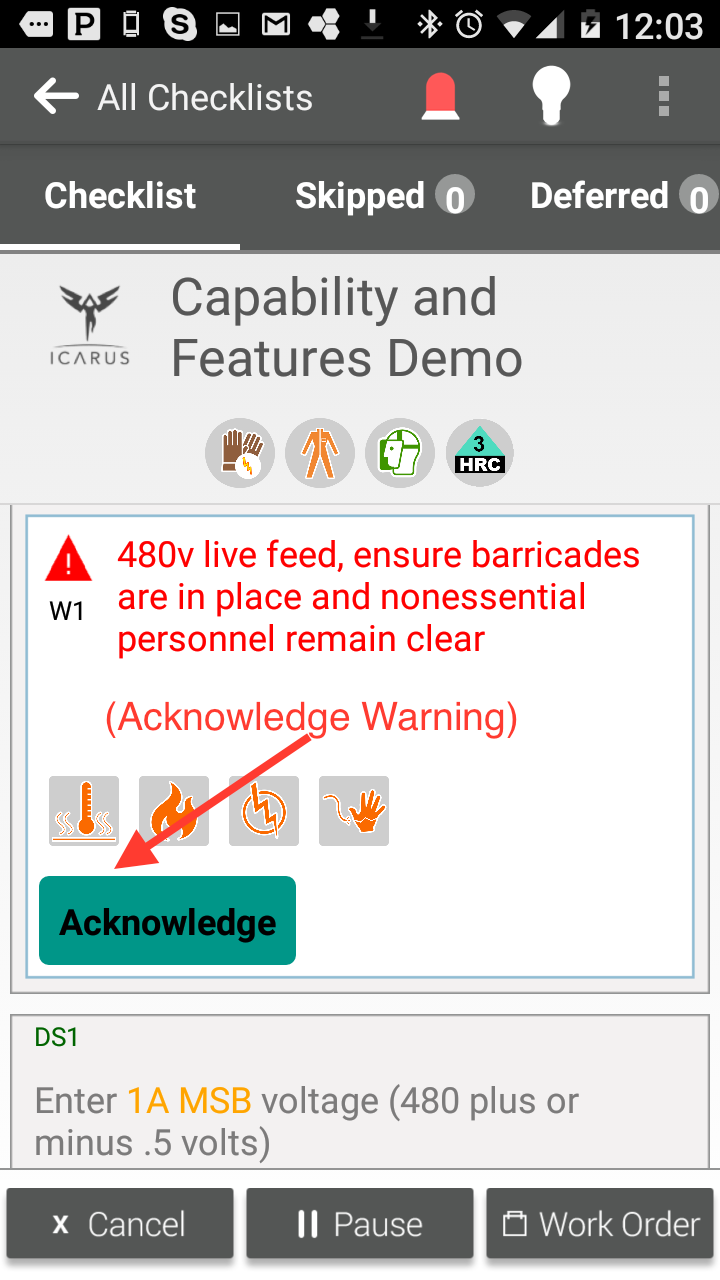
The problem is timing. Crews hold the pre-job safety briefing at the start of the shift, and seven hours later they are about to encounter the hazardous step. ICARUS Ops EES puts a warning right before each critical step, so the crew confirms the right PPE is on, the other controls are in place, and everyone knows the hazard in front of them.
See a sample ICARUS Ops EES procedure
See a sample ICARUS Ops EES procedure
Demos are for teams actively evaluating software for deployment.
Frequently asked questions
What is an arc flash risk assessment?
A review required by NFPA 70E before work where an arc flash hazard may exist. It identifies the hazard, estimates its likelihood and severity, and decides the protective measures and PPE.
What is the first control for arc flash risk?
Elimination: de-energizing the equipment and establishing an electrically safe work condition, where that is possible.
Can software reduce arc flash risk?
Software does not change the hazard. A digital procedure can help crews follow the controls your risk assessment chose, in order, and keep a record.